Category Archives: Learn New Skills

#80 Practise baking a Sourdough Loaf … again … and again … and again …

It all began when a friend suggested we attend a one-day sourdough baking course run by the Bicycle Baker, local artisan bakers who sell delicious sourdough loaves around the Albury district.

The idea of learning how to make them at home was very appealing. Who doesn’t love the smell of freshly baked bread in the morning, the crunch of biting into a perfect sourdough crust and the unique taste and texture of hand-baked bread?

It was at this point, I should have shrugged and said, “Nah. Why bark when you have a dog?” After all, it was no trouble to nip down to the shops and buy a loaf. Takes me ten minutes, tops.

But no, because I’d done a bit of yeast bread-making years ago I thought it would be a quick refresher and I’d have the aroma of freshly baking bread wafting around my kitchen in next to no time. I expected this blog post to be titled #80 Bake a Sourdough Loaf.

Ha!

Here I am, weeks later, agonising over every step of the procedure as this activity morphs into:

#80 Practise baking a Sourdough Loaf … again … and again … and again…


The class was great fun and we all went home with a fresh, delicious loaf of sourdough bread.

What I hadn’t appreciated was the effort that Nicky and Tim, aka the Bicycle Bakers, must have put in over the preceding weeks to help us all produce these perfect loaves on the day. Baking a sourdough loaf is nothing short of a protracted labour of love.

The sourdough starter is the secret, that magic ingredient used as a leavener in lieu of commercial yeast. Sourdough starter is needy. Very needy. In fact, we were advised to give a name to the little blob of sourdough starter we were handed at the end of the course. That’s because it has to be fed regularly, nurtured with care and even taken on holidays, lest it die of neglect. Like I said. Needy.

I thought of calling it Bear, so the phrase ‘Feed the Bear’ could become my daily mantra, but before long, I changed its name to Bambi.

Because I didn’t want to be the one to kill Bambi

The magic of sourdough starter is that it begins life as nothing more than a mixture of baker’s flour and water. But after daily feedings—you discard 80% of the previous day’s mix before adding fresh flour and water—you eventually have a little jar of bubbling, wild-yeasty-smelling starter that gets better and stronger the more times you feed it.
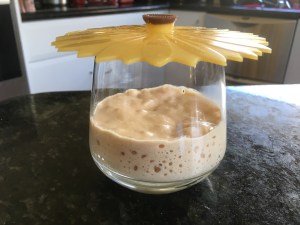
                                                                   Modern day Bambi

If I may be allowed to mix my mythologies, Bambi can only be used for bread making when he reaches the Goldilocks point: not too bubbly, not too flat, not too whiffy, not too bland. I’ve learned through trial and error that this Goldilocks point is rarely reached at a convenient time for baking bread.

But once that moment arrives, you mix Bambi with your bread flour, water and salt, do a little kneading, then leave it to ‘prove’.

For THREE to TEN HOURS!

By now, it’s about four in the morning, but you’re so invested in your loaf that you get up to work it into its final shape, let it rise once more, slash designs on the top as best you can to let out steam,
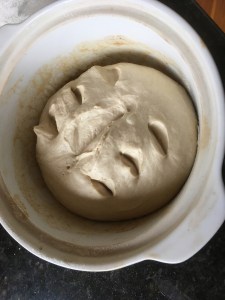
then place it in a preheated oven that will never be as hot or as reliable as a commercial oven.

If you’re lucky, you may end up with a loaf that rises tolerably well and browns nicely.

When cut, it even has the look you’re after.
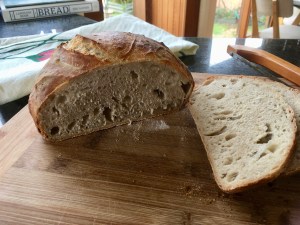
And the taste … ?

Hmm. It’s ok…ay.

But maybe I’ll nip down to the Bicycle Baker’s and buy a loaf to tide me over before my next marathon session.

Or I could just list Bambi on GumTree. Free to a Good Home, of course.
 

#79 Découpage a Table

Such an evocative word, découpage.

It conjures images of hidden Parisian streets harbouring tiny shops containing all manner of long forgotten artisanal works, like hand painted marionettes lying on a dusty bench, or glimmering, lacquered trays adorned with olde world photographs.

So now I have the time, why not give découpage a try?

#79 Découpage a Table

Put simply, découpage involves cutting out pictures, gluing them to an object and then coating the pictures, and the object, with layers of varnish.

But exploring this activity has led me to the realisation that there are two distinct forms: the Art of découpage and the Craft of découpage.

The Art form involves exquisite design and a dedication to perfection. Beautiful pictures are chosen, meticulously cut out and then pasted onto a surface in ever increasing and overlapping patterns. Layer upon layer of varnish is applied, with careful sanding between coats. I’ve been told up to 70 applications might be in order. This results in a finished design that shines with a glorious lustre and depicts a three dimensional scene with depth and colour the envy of any Renaissance painter.

The Craft form, however, involves cutting out a pretty design, pasting it onto a surface, then coating with—oh, maybe five or six applications of varnish. This form of découpage has any number of YouTube and Pinterest and Instagram examples. I quickly realised that this was my level of découpage.


Step one: Select your surface

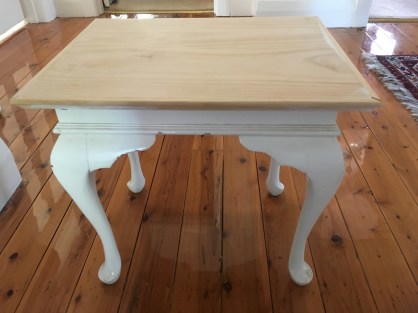
I had an old Queen Anne dressing-table stool of my mother’s which no longer had its dressing-table and so cried out for conversion to a small side table.  After removing the cushion insert, my talented Bunnings Buddy was able to make a solid table top for it. All it took was a coat of paint to make it ready to be découpaged:


Step 2: Chose your pictures

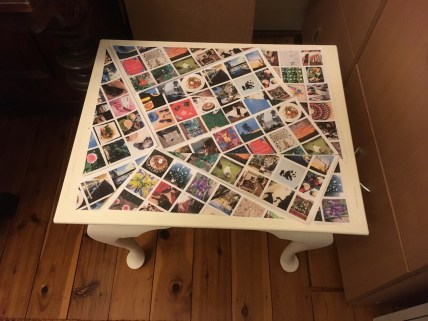
This is where the artistic skill comes in. Choosing a montage of photos I’d taken over the years, my original plan was to stick these on before varnishing:But it was pointed out to me, by someone with more artistic skill than I, that this was looking like a table littered with old weekend magazines. Not quite the image I was after.

Then I thought of using a photograph of a bunch of gorgeous flowers a dear friend had sent me recently, after she stayed for a weekend: So lovely, but could this be enhanced even further to incorporate the idea that a découpaged piece should have hidden depths behind the picture?


Step 3: Increase the level of complexity

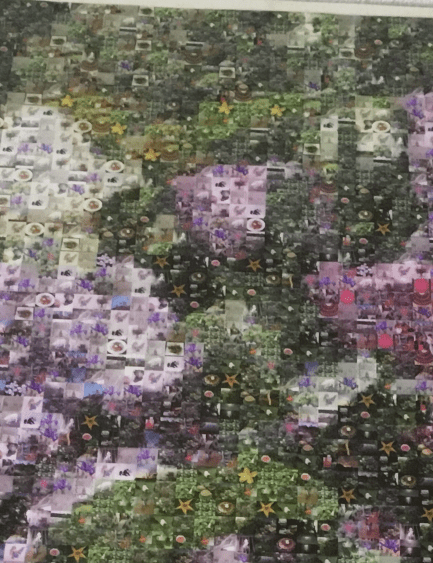
It was then I hit upon the idea of turning this photo into a photomosaic, using dozens of smaller pictures from my photo album.

So I turned to a clever website that allows you to instantly turn your photos into photomosaics. Simple to use, and free—or, if you’re after a higher definition, relatively inexpensive—the image it produces can then be copied across to a USB for printing at a photo shop.


Step 4: Glue and varnish and sand, glue and varnish and sand …

After a few days of glueing and varnishing and sanding the photomosaic, the final result wasn’t half bad:And if you look very closely at the picture …No, go in closer…you’ll see the entire picture is made up of hundreds of tiny snapshots of a life.

Now this is going straight to the pool room!


#77 Learn the Art of Successful Marketing

How good is Marketing?

I’ve been persuaded from recent Australian events that marketing works in miraculous ways, even if what’s being sold appears to be a pretty uninspiring product.

The other lesson I’ve learned is that money isn’t the important issue in marketing. Know-how is. I’ve heard you can spend upward of $60M on advertising and still end up a loser.

So because my sister and I now have a novel—Secrets of the IN-groupto sell, these revelations have naturally inspired me to

#77 Learn the Art of Successful Marketing

If it works for a very mediocre product, how much better would results be for a more appealing one?

And it follows, of course, that if we have a go [at marketing], we’ll get a go [at fabulous sales].

So I turned to Google to learn the basics of Marketing.

Choices, choices:
My immediate preference was, of course, to go straight to the site called “Skip Marketing 101 and read this instead”. I’m beginning to understand that clever marketing is quite devious, because after I’d done an in-depth study of their eight important rules for successful marketing, I realised they sounded exactly like the eight rules on every other Marketing 101 site I’d passed over in my haste to use this one.

So here they are, plus my attempts to follow each tip.

1. Not Marketing is Not an Option
Okay, this is a given. Who believed that Kevin Costner film claiming that “if you build it, he will come”? As if.

2. On-line display advertising can have a big impact for little cost
Sounds good, but does this work for just the one book? Possibly best to target websites that reach women-of-a-certain-age—who are looking for an up-lit read. It sounds like more research might be needed to find out where to best position our advertising.

On the other hand, sending out short press releases to the local newspaper and radio does work wonders. We scored a couple of interviews and a photo plus advertising for the local bookshops stocking the book.

 3. Play on people’s love of events
This one’s turning out to be true so far. We did a U3A talk framed like the ABC’s programme “You can’t ask that” and it went very well. The questions: “How did you not kill each other during the writing?” and “Are you two still talking to each other?” seemed popular, so we’ll be doing more of these.

4.Make the most of your website
I’m trying to. At this very minute …

But it looks like I’ll have to sort out how on earth I post details about purchasing the book at the top of every blog entry from now on.

In the meantime, if you’d like to buy a print book in Australia but can’t easily access one from your local bookstore or on-line, just email us on regal.525@gmail.com and we’ll get back to you to arrange it.

4.Email marketing is the new direct mail
Because we all love getting unsolicited emails, don’t we? And isn’t getting in touch with long lost friends just to promote your book a bit … icky?

I’m learning you need thick skin to be a really successful marketer.

 6. Social media is the new word of mouth
I know this deep down, but posting the book’s cover on my Instagram feed garnered all of eight Likes, tweeting about it scored just one Like—and the idea of actually using Facebook horrifies me. I guess this tip helps the most if you already have a large social media presence.
Perhaps the fact that our book is about how older women don’t feel entirely comfortable using social media should’ve been a giveaway that this strategy wasn’t going to be the best for us …

7. Win with loyalty rewards
Sure, why not. Here’s an offer no person can refuse. Buy nine of our books and get the tenth one free!!

Oh, hang on. Who’d want 10 copies of the same book?

8. Build a network of relationships

Aargh!! Marketing-speak! Get me out of here.


What this activity has taught me is that I have a new-found, grudging respect for the successful marketers out there.

It’s not as easy as I thought …


#75 Learn to Tessellate

It’s a sad fact of life that there are always massive gaps in one’s eduction, and the most glaring one for me is in the field of art.

Thinking back to my school days, I have no recollection of any enjoyable art classes and no instances where I learned any techniques or tips about either art execution or art appreciation.

So it’s only recently, thanks to hearing about the Escher exhibition in Melbourne, that I gained a minuscule understanding of design principles, which has now made me to want to:

#75 Learn to Tessellate

Although I didn’t make it to the exhibition myself, several friends raved about it, so we had an Escher afternoon where photographs were shared and we discussed various aspects of his life and work.

Being more scientifically inclined, I chose ‘Escher and Mathematics’ as my topic. Talk about naive. Escher is mathematics! Why was this information never explained to me in those rudimentary art sessions I had in primary school? Or in the more complex maths classes I enjoyed at secondary level where they didn’t bother to mention there might be a functional aspect to recurring decimals? Like I said—massive gaps in my education.

It turns out that “Mathematics as it applies to Escher’s work” is a topic way too complicated for a ten minute dissertation over afternoon tea.

How on earth did he conceptualise something as glorious as Sky and Water I ?

So the best I could come up with for my contribution to the afternoon was a short demonstration on how to do a very basic tessellation, also known as how to cover a surface by repeated use of a single shape, without gaps or overlapping. The technique can result in an endless array of mosaic designs and gives one a certain modicum of personal satisfaction.

There are some excellent YouTube tutorials on making a tessellation here and here so I followed one of these and managed to produce something that might scrape a pass in an art exam in grade two or three. Quite an achievement!

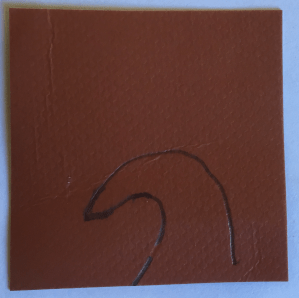
I began by cutting out a small square 10cm x 10cm and drawing a curvy design along one side like this,

before cutting the shape out precisely, sliding it across to the opposite side of the square and aligning it perfectly before taping it down like so:

Then I drew another design on the adjacent side of the square, cut it out, slid it across and taped it too:

This little brown template was then used to trace a design onto a larger sheet of paper repeatedly, and

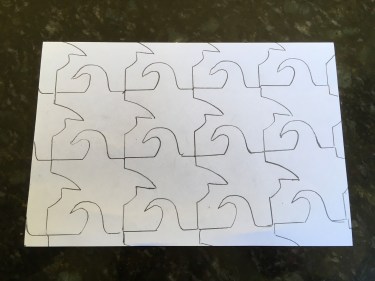
… thanks to the magic of design and recurring patterns, it fits perfectly into itself—over and over:

All that’s needed is a peaceful 30 minutes to colour it in and to add a few markings.

Presto! I had an original design—

This is possibly the most artistic thing I’ve ever managed to create.

I love you M.C.Escher!

#68 Become a [virtual] Plane Spotter

Among the myriad advantages of living in a regional city (think smaller mortgages, houses with real gardens, bushland close by, a ‘rush hour’ known as a ‘rush couple-of-minutes’, and proximity to a Bunnings or a Spotlight) is that the airport is situated thoughtfully close to town. Which was the impetus for my latest activity:

#68 Become a [virtual] Plane Spotter

My home is under a flight path, which isn’t as bad as it sounds. Smallish planes might go over a few times a day depending on the prevailing wind direction. They’re like comfort food as I look up and think, ‘Ah good, the 4.50pm from Sydney’s running on time. All’s well with the world.’ 

Recently, a Local Council newsletter advised us of a website called ‘flightaware‘ where all the comings and goings of aeroplanes into, out of, or over Albury can be followed in real time.

By visiting this site it’s possible to explore the once secret and sometimes silent world above us. That white streak in the distant sky or the plane coming in overhead to land can be identified and followed without leaving home. (And I thought online jigsaw puzzles were a marvellous way to waste time.)

All this activity above us, all the time. Who knew? 

And by clicking on any one of these tiny icons, it’s possible to find out anything you want to know about that particular plane. Its origins, who owns it, where its travelling to, if it’s on time. It’s like Facebook for planes.

But more exciting than this is the chance to track planes on their descent into Albury Airport, watching their blue icons get closer and closer to their destination before the little aeroplane blip suddenly – poof! – disappears.

The distant roar of the engines thrusting into reverse tells me it’s landed safely.

Flights are not always as straightforward as you’d expect them to be, though. What, for example, was this pilot up to in the first few minutes after he left Albury? 

                                                                               Wouldn’t you love to know. Specs left at home?


Recently, while I was doing some virtual plane spotting on my iPad in the kitchen, I noticed that three planes, a Rex, a Qantas and a Virgin, all from Sydney, were coming in at about the same time. The battle that ensued in the air for pole position was quite mesmerising.

Straightforward at first, the three blue planes are all lined up, Rex leading across the Hume Weir (which I now realise looks surprisingly like a whale’s tail), followed by Qantas then Virgin …

… spaced perfectly so they’ll arrive in sequence.


But wait! Qantas takes a quick turn left – heading backwards! Oh no, he’s ceding second place to Virgin.


In an instant, though, it changes again. Virgin loses confidence in her position and takes a quick turn to her right – also heading backwards – to leave the chequered flag for Rex, no competition!


Once Rex lands and his blip disappears, it turns into a tussle between Virgin and Qantas for second spot as they appear to do aerial acrobatics. 

Don’t ask me what this is all about, but surely someone needs to look at the scheduling timetable if it’s this messy to get them all in safely.                                                    By now, Qantas has totally lost the plot. He’s coming in a distant third


But apart from the sporting aspects of virtual plane spotting, there are some very practical advantages too.

If I’m going out to the airport to pick up any incoming passengers, I can see well ahead of time if their plane has left its destination as expected.

AND, I can time my departure from home so that my seven minute car journey to the airport begins when the blue blip of my passengers’ plane indicates it’s exactly seven minutes away from the airport. Needless to say, it’s taken some time and complex calculations to work out where, exactly, the plane’s sweet spot is. Oh, the satisfaction when we both arrive at Albury airport simultaneously.

No more having to pay the Council parking fees at the airport should I be left hanging around waiting because the plane was running late.

Hang on a minute. Maybe Council should have thought this through before they let us in on the secret…

#67 Rediscover Jigsaw Puzzles

Following a recent posting on this site about investigating a mystery, a friend told me about Mystery Jigsaws.

As I’d recently set up a new jigsaw puzzle in the living room, this was interesting news. To think I’d reached retirement age without ever knowing that all jigsaws aren’t made to the same formula. The mystery ones, apparently, provide a murder scenario where completing the picture provides the solution – or at least gives you further clues needed to solve it. Sounds intriguing.

My friend has promised to loan me one of hers once I’ve completed the behemoth that is crowding out my home at the moment.

But this news got me thinking about whether there are different ways to enjoy doing jigsaws.

#67 Rediscover Jigsaw Puzzles

Because unless you live in a multi-roomed mansion, they really are quite unwieldy and space-hogging.

This view of what’s happening at the moment will show you what I mean (and I had to move it from the living room onto a bed and crowd it all together just to fit it into this panoramic shot).

First, there’s the large board – backed with non-slip material – needed to support the emerging puzzle, then the almost-as-large, also non-slip board to house the pieces that are still homeless, plus the inverted lid for further leftover or special pieces and of course the all important lid photograph to help with identification and placement.

It’s the stuff of nightmares if the living room has to be reclaimed when visitors arrive.

And don’t get me started on the risks of losing pieces and never being able to complete the final picture to your complete satisfaction. Or the discomfort of bending forward in an extremely uncomfortable position whenever you work on it. Or the horror possibility of the dog jumping on the boards and scattering pieces as he romps around. (Yes, he did.)

Not to mention that French puzzle I tried to complete during the Olympics. It not only had the last piece missing, but gave me a duplicate bit I didn’t need, instead!

Who’s ever seen this before?

But I may have found a solution to all these problems.

After a visit to the App Store, I downloaded this for iPad:

Does this mean there are ‘adult-friendly’ jigsaw puzzles? Ooh…

If 8.92K users score it 4.5 stars, it must be pretty good.

And it is.

Its maximum size is 550 pieces – but they can be rotated to increase the degree of difficulty – and you scroll up and down in the side panels with a flick of your fingers before dragging the required piece into place, beginning, as usual, with the borders.

AND you can change the background to suit your picture, choosing from an assortment of colours available. From this:

…to this …

to the boring, but easier-on–the-eyes:

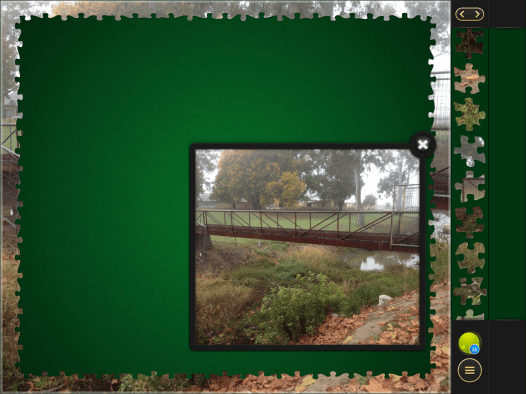
AND, if you click on the round icon at the bottom of the screen, you can simultaneously view the whole picture while you’re solving the puzzle. The image can be dragged and positioned so it’s never in the way:


AND, by upgrading the app for a few dollars, you can use your own photos to create jigsaws, which also removes the advertisements. (That’s Oddies Creek, above, near home) .

NO missing pieces, NO extra pieces, COMPLETELY transportable, NO back strain, NO space restraints and NO dog incidents. And did I mention the satisfying ‘click’ you hear when a piece fits into place?

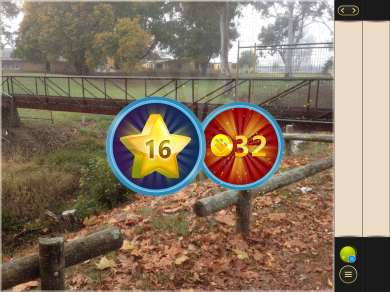
AND you get a gold star when you complete it!

Something rather unexpected has happened, though.

Waiting endlessly for doctors’ appointments, for late trains, or for fog-delayed planes is such a pleasure now.


#64 Make a Silk Necklace out of a … Silk Tie

There will come a time, probably in the not too distant future, when scientists will be able to make a silk purse out of a sow’s ear.

Seeing they can already turn pig connective tissue cells into stem cells, and create any manner of products using 3-D printers primed with stem cells, they may already have done it.

But until I get a 3-D printer at home, (don’t laugh, Aldi had them on sale recently for $299) I’ve settled for the next best thing:

#64 Make a Silk Necklace out of a … Silk Tie

A friend introduced a group of us to this technique at a fun afternoon workshop recently, and I’m sold on the technique.

So here’s the brief.

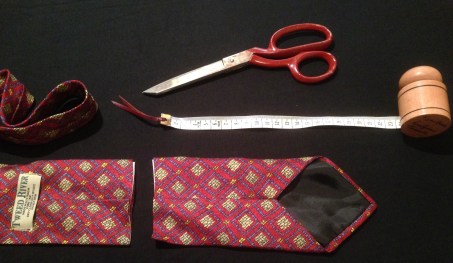
You’ll need the following materials:

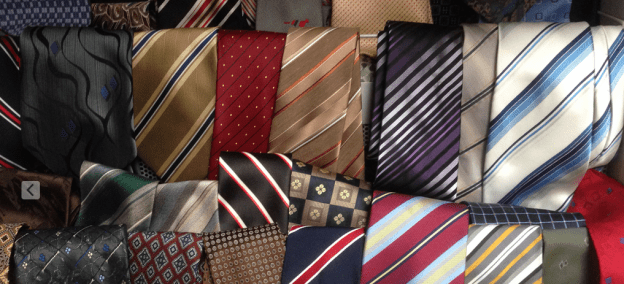
One unwanted silk tie, the brighter the better
Tape measure, scissors and matching coloured thread
One chopstick or knitting needle
5–7 wooden beads 25mm diameter, 1 fastening hook, one 7mm jump ring & two 15mm plain rings (from Spotlight or Lincraft)

The technique isn’t too complicated.

First, cut off the bottom 20cm of the tie – 

Then unpick the remaining long piece and discard the lining –

Next, press the tie open with a hot iron, protecting it from burning by using a tea towel on top.

You should end up with a very long piece of silk fabric, narrow along most of its length but getting much wider at one end.

The aim is to trim this very long piece of uneven silk fabric into a perfect, long, thin rectangle, so it can ultimately become a perfect tube.

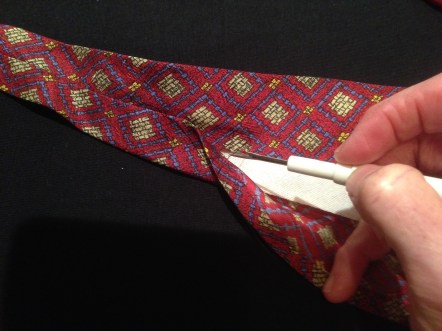
To achieve this, fold the right sides of the fabric together lengthwise, measure the narrowest width and pin the tie all the way along its length to this width, just so:

Sorry, it’s a bit too long to photograph the full pinned length…

Then cut just below the pin line and discard the wider pieces of fabric you’ve cut off.

If you then trim the ends at an angle, you should  end up with something like this:

in other words, a long, thin silk tube waiting to be sewn closed

Stitch along the length of the tie, leaving one end open but sewing the other end closed at an angle. It’s quickest with a sewing machine, but can be hand sewn. Perfection is not a prerequisite. (Just make sure the tube is wide enough for 25mm balls to fit through). 

Now comes the fun part.

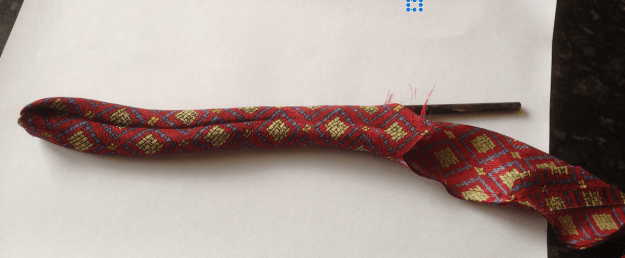
Once the sides and one end have been sewn closed, it’s time to turn the fabric tube inside out. Because it’s silk, it’s nice and slippery, but this manoeuvre is helped with a little patience and by using a chopstick or knitting needle to cajole it through.

The result is a silk tube, closed at one end, with the right side of the material facing out.


Assembly time:

Sew  the closed end around one of the 15mm rings.
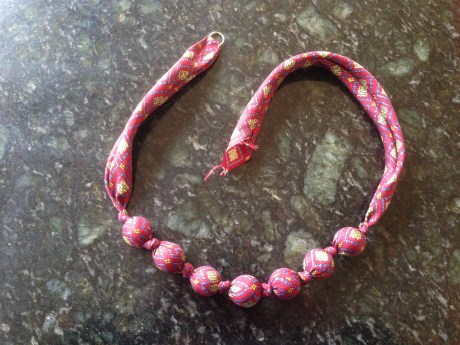
Then tie a knot about 15cm from this end, slide a bead through the tube until it hits the knot and hold it firmly in place as you tie another knot in the fabric.

Repeat the process until all the beads have been put in place firmly with knots between each one.

You’ll have a balanced necklace if you use an uneven number of beads:

Finally, stitch the open end closed, attach the second round ring and add the split ring and clasp.

Voila!

I should warn you though, once you start,  it’s impossible to stop at one.

There’s barely a silk tie left in any Op Shop in a fifty kilometre radius of home…


#63 Investigate a Mystery

Enid Blyton must take some responsibility.

The idea that you can spend years entertaining children with exciting tales about other children solving mysteries (The Famous Five, The Secret Seven, The Five Find-Outers & Dog) without it having repercussions in their later life is fanciful. Without a doubt, it’s the reason I’ve always had a deep seated urge to solve mysteries. And this need continues well into retirement.

#63 Investigate a Mystery

It began back in mid January when my sister bought me a birthday present online to be sent directly to my post office box. But when my birthday came and went and I hadn’t thanked her, she realised the item had gone missing, and so began the investigation initially known as The Mystery of the Missing Parcel. 

No problems. A copy of the original Australia Post receipt, showing its tracking number, should set things right:

But when we checked on the Australia Post website, the parcel appeared to have been delivered to my local post office two weeks earlier, just a few days after it had been sent.

…curiouser and curiouser

A trip to the post office will sort this out, we thought naively. The gift will be there, sitting on a bench waiting to be collected. It did seem odd, though, that they hadn’t placed a ‘parcel awaiting collection’ card into my PO Box.

‘No,’ they told me. ‘We don’t have the item here. It’s already been picked up.’

Not by me it hasn’t. Who signed for it?

They shrugged. No one has to sign to pick up parcels any more nor show any ID. Even when the parcel’s been registered and the sender took out extra insurance. Naturally, I made a fuss. It was my birthday present after all. They finally offered to look at the CCTV footage taken of the Post Office collection hatch at the exact time the parcel had been collected –  ‘11.28am Mon 22 Jan’ – to see who’d picked it up.

And this is where the story takes a darker turn. An unidentified man was seen on CCTV taking possession of an identical box to the one I was awaiting at exactly that time. This was no longer a simple mystery, this had turned into a crime.

The birthday present, it turned out, was a box housing four bottles of Vino Cotto, an elixir so delicious that, well, it just had to be found or someone would have to pay. My sister had recently discovered that this little gem was being made to the original Italian recipe right here in Australia.

Its literal translation is ‘cooked wine’ but it’s so much more than that.  Making vino cotto involves the long, slow reduction of grape ‘must’, the juice of a particular variety of grape, with the addition of ash from the burnt grape vine. The resulting rich, exotic syrup is then stored for months before being brought out for special occasions.

When I was a child, my grandmother would slave over its production so that every Easter it could be retrieved from storage and served drizzled over Crostoli as the entire family – parents, aunts, uncles and cousins, scrambled for the last drop of this liquid gold. Making it was so laborious, so complicated that we all knew we’d not see it again for another year.

That did it. No strange man was going to get away with my birthday bottles of vino cotto, so I swung into investigative mode and set up my white board.

IMG_3903

I’ve concluded my investigations now and have decided the most likely sequence of events is as follows:

  • The box arrives at the post office on 22 January
  • The staff place a ‘parcel to collect’ notice in the wrong PO Box. Exhibit A shows a photo of PO boxes in close proximity to mine. Exhibit B (taken peeping through a slatted grille) shows the boxes snapped from the reverse angle. Quite a jumbled mess, suggesting it would be simple for the ‘notice to collect’ to be placed in the wrong box
  • An unidentified man, probably with a PO Box close to mine, takes this incorrectly placed notice from his PO Box into the collection hatch and is given the parcel, no questions asked. It doesn’t worry him that he’s not expecting a birthday present and that it isn’t addressed to him either
  • Aforementioned unidentified man then takes the parcel home, opens it without any concern that his name is not on the label and that it isn’t his birthday, sees the word ‘Vino’ on the bottles and thinks all his Christmases have come at once.

The Post Office hasn’t taken kindly to my suggestion that they place a WANTED poster sporting the unidentified man’s image on every billboard around town, so I have little hope of discovering his identity.

But a couple of things cheer me up. Australia Post has finally refunded us for the value of the goods so I’m expecting more bottles of vino cotto to arrive any day now.

And best of all, unidentified man wouldn’t have had a flood of lovely childhood memories as he indulged in my vino cotto and I trust he was bitterly disappointed to discover that, despite being utterly delicious and addictive, it contains no alcohol whatsoever.


Yay!

My culprit may remain elusive, but three bottles of vino cotto PLUS a jar of marinated wild baby figs in vino cotto arrived at my door (thank you to Angela from Il Baronello) in time for Easter. Just drizzle over fresh Crostoli.

The verdict?

Squisito!


#62 Take a 30-Day Challenge

Every time something like Feb Fast, Movember or a so called ‘fun-run’ comes around,  I’m itching to join in the party, but so far, I haven’t found any cause that’s grabbed me enough to want to commit to it. Being an extremely light drinker would make Feb Fast way too easy, Movember is out for obvious reasons and I refuse to be involved in anything whose name reads to me like an oxymoron.

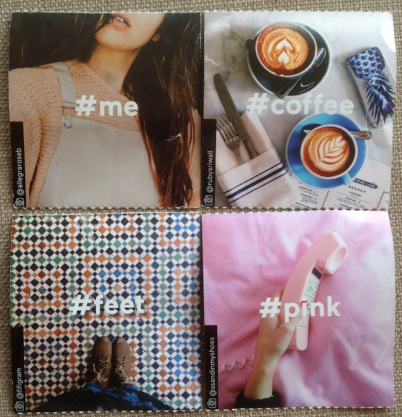
While the idea of giving up chocolate for a month is too ridiculous to contemplate, an opportunity did present itself recently when I came across a small box in a trendy gift shop that suggested I

#62 Take a 30-Day Challenge,

pick up my phone, and shoot a photo a day, following their suggestions for the topic.

“Don’t shoot what it looks like. Shoot what it feels like,” David Alan Harvey’s quote on the back of the box exhorted me. What a way to improve my skills, I thought:

It was only after I’d bought the little box that all was revealed. Hidden in the small print – once I’d ripped it open – was the awful truth. This was an Instagram challenge. Or should I say, #Instagram #challenge?

Now I made quite derogatory comments about this particular social media activity in an earlier blog #50 Find the App of Your Dreams and discovering that the first four days’ suggested shoots were

– all a bit self absorbed, trivial or pointless –  didn’t help my frame of mind. That’s it, I thought. This is not the right challenge, thanks very much and even though I’ve spent money for the box.

But then I realised that maybe a challenge should be a bit uncomfortable. So with that in mind, plus the encouragement of a younger friend who promised to ‘follow’ my Instagram posts and who’s the bee’s knees with social media (she makes top class podcasts for a Sydney Arts Organisation, do you mind!) I plunged in.

I’m up to Day 15 already, dutifully following the daily instructions my little box of surprises throws up, and what began as a task akin to making a silk purse from a sow’s ear has morphed into a most enjoyable, although not always easy, challenge.

What’s a novel way to present a #selfie? Is there a new interpretation of the ubiquitous #coffee photo? And how is it possible to depict #texture in a two-dimensional picture?

#Instagram cleverly allows you to apply filters to your photos, which makes them look almost professional. A website titled Your Instagram Filter Cheat Sheet by Lucille Zimmerman has been a marvellous help for artistically-challenged folk like me.

So here are a few of my posts to date:

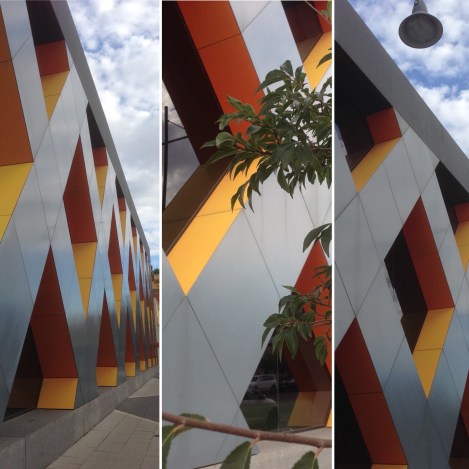
#architecture

Albury’s own LibraryMuseum


#books

They can change your life


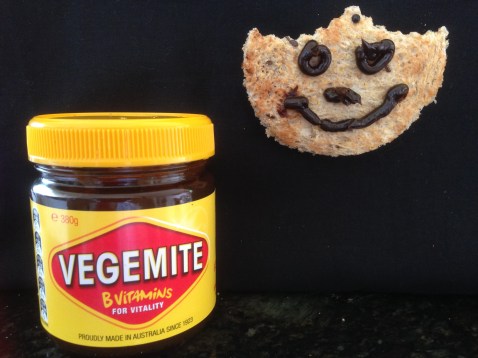
#happy

a sing-a-long to the Vegemite song is mandatory


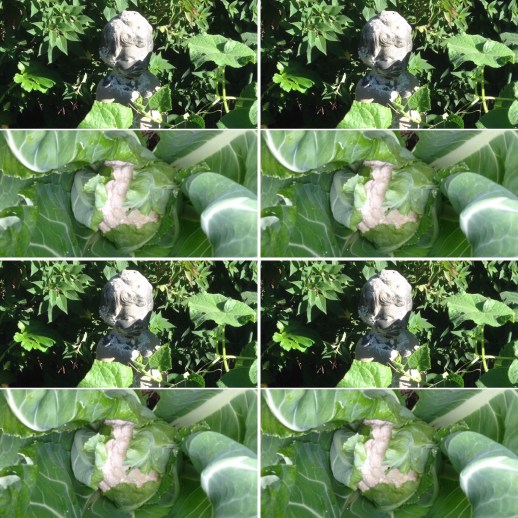
#greenlife

Just practising Instagram techniques, now!


#art

Glorious little parrot painted by my friend Heather one afternoon recently


I’ve managed to garner a few ‘likes’ and even a few ‘followers’ over the two weeks I’ve been posting to date, but everyone using Instagram seems so young and gorgeous and uber successful.

But that’s its beauty, I guess. As long as I never post a shot of myself, I can pretend that I’m twenty or thirty-something, beautiful and just like them!


#61 Upgrade Christmas Crackers

January again.

That month after Christmas when it’s too hot to move out of your own shadow, so the country takes its month-long siesta. Which means it’s the perfect time to

#61 Upgrade Christmas Crackers

You may be thinking that the weeks following December 25th aren’t the most logical time to do this, but there are several reasons why January is, in fact, the perfect month to begin:

  1. The memory of how disappointing Christmas crackers really are is fresh in your mind.
    Pretty as a picture with a cracking start they plunge downhill after that.
    Paper hats that make the beautiful look plain, and the not-so-beautiful look plain and silly, and jokes that would cause any self respecting dad to weep. [‘Q: WHAT DO YOU CALL A HORSE IN PYJAMAS?  A. A ZEBRA’   Really? After two hundred thousand years of evolution, this is the best we can do?]
    The final blow, of course, is the useless, tacky, plastic toy that’s destined for landfill.
    Sigh.
  2. In January, the big department stores offload their unsold Christmas crackers for peanuts. I found a box of six very elegant ones, normally priced at $75 for half that price. However, $37.50 still seemed a bit steep for higher quality paper, a louder cracker bang and a slightly better class of rubbish inside.
    In the end, I lashed out on this box of ten crackers for – wait for it – 50 cents. For the entire box.
  3. By starting this project now, you have a whole year to discover more flattering festive attire than a flimsy paper hat, find jokes that are truly rib-tickling, and source tiny thoughtfully chosen items that can be tucked into existing crackers. Hand-picked treasures to match the interests of family and friends.

The first task is to gently disembowel the crackers of their contents, taking care not to damage the cracker strip.

Enter the toaster prongs – perfect for the job

Not confined to the kitchen any more

After removing the small bow and straightening out one end, it’s an easy job…

…performed with surgical precision

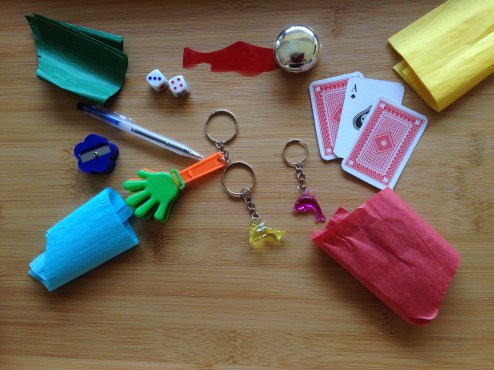
While the contents may have delighted a child in the 1950s, they don’t quite cut it any more:

Although at 50¢ for the lot, it seems churlish to complain

Now comes the fun bit: thinking up ideas for better gifts that are small enough to fit into a cracker and will give the recipient a lovely surprise.  And you have a whole year to find them! Twelve months to keep an eye out at stationer’s supplies and hardware stores, garden centres and kitchen shops, and every retail establishment you might enter between now and December.

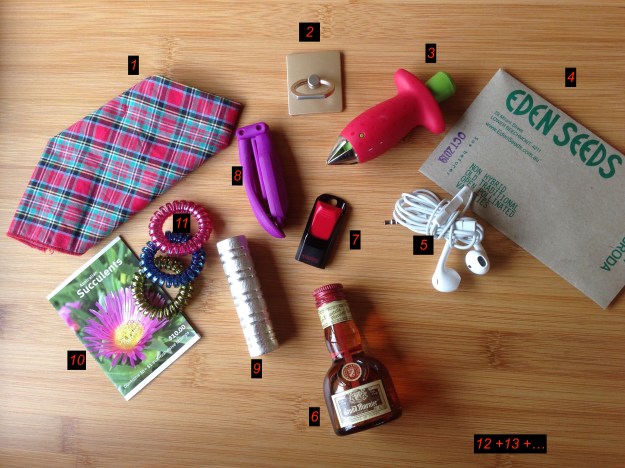
A quick scout around home has turned up a few ideas already:

  1. Brightly coloured handkerchief – large or small
  2. Mobile phone hook – it attaches to back of the phone, rotates 360º and lets you hang it in the car, slip it on your finger or rest it on an angle for photo taking or viewing
  3. Strawberry huller (yes, really)
  4. Garden seeds – for the green thumbed
  5. Ear buds – for the podcast devotee. Handy to have more than one set…
  6. A wee nip – for comfort
  7. A USB stick
  8. A mini book-reading light
  9. Lipstick
  10. Book of stamps – remember them? Still needed on the rare occasion.
  11. Hair bands
  12. + 13 + …    = Your imagination.

Finding a glamorous alternative for paper hats has proved much more difficult. Does anyone look good in one?

So what about including larger colourful handkerchiefs for folk to tie rakishly around their necks during the festivities instead? At least there’d be a use for them after Christmas. A few colourful paper hats for the littlies mightn’t go astray, though.


Finally, write down the best jokes or the pithiest tweets or the funniest comments you hear throughout the year. They’ll be perfect to include in the cracker when December rolls around.

Or better still, ask a relative to come up with some bespoke cartoons. You never know your luck: